Showing posts with label Gardening. Show all posts

Wednesday, April 20, 2011

Spring!

It's spring in New England.  That means it's freezing outside, although not literally (most nights).  We have started some seeds indoors and they are looking not quite as weak as they have looked in the past.  Although I'm pretty sure that, as it is almost May, our tomato plants are supposed to be more tha three inches tall with only one set of true leaves.  But they look better than they did last year and that's the important part.  We haven't started too much more indoors.  We do have some things growing in the cold frames:  leeks, cabbage, lettuce, spinach.  We have planted some things in the ground already too: peas, kohlrabi, beets, sugar snap peas, snow peas, sorrel, chamomile, borage, and mallow.  We have things coming up, mostly flowers at this point, but also the strawberries look like they'll do well, the tarragon, oregano, chives, thyme, and savory are back.  The garlic is up and that's pretty exciting.

 Cilantro form the cold frame, this has been growing all winter
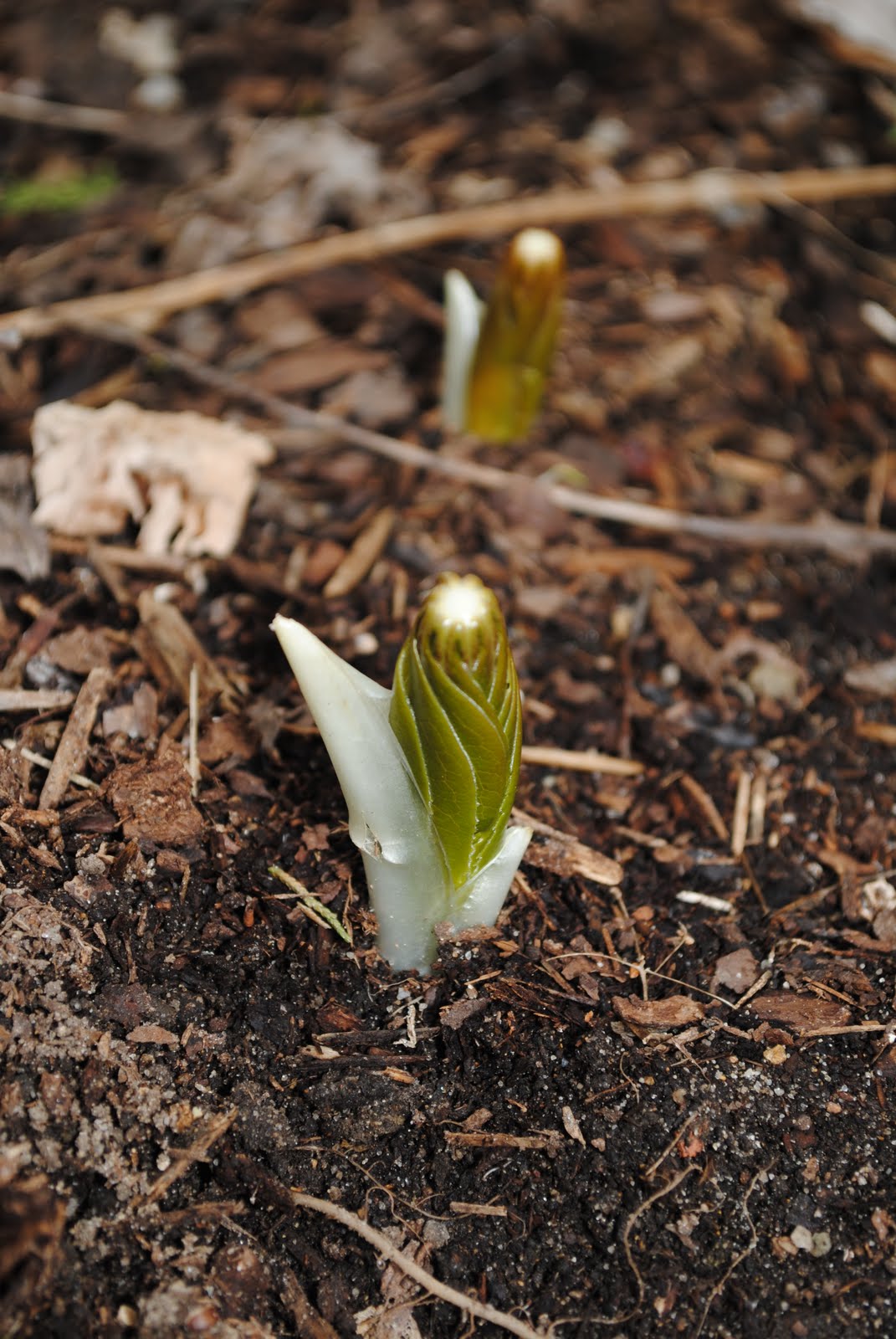
Blood root, these grow all by themselves in my back "wilderness"
Chives are up!
Strawberries
Leeks in the cold frame
Sugar Snap Pea Shoot
Lettuce coming up in the Cold Frame
Last fall's chard and some volunteer cilantro in the cold frame.
Garlic up!
Blue Bells
May Apple
Mint
Knotweed
Motherwort
Tarragon
What has also been exciting is the fact that this year we got to plant seeds into beds that were built last year.  We didn't even have to buy, cut, screw, dig, have loam delivered, or anything like that.  Not to say that that won't be necessary in a few weeks.  The garden I made last year of some native perennials will have to be dug up, transplanted to an area that will also have to be dug up. This area will then have its soil go through a sort of spa treatment over the course of the summer, have a winter cover planted on it and be left to be the vegetable garden for next year.  We have learned not to rush things (sort of).  This is an exciting lesson because we have a tendency to count our chickens before their hatched, buy our chickens before their home is built and order enough seeds to plant a few acres when all we have are four 4x4 foot raised beds. 

We're just excited. And incredibly, unbelievably, remarkably impatient.  I am so impatient for all the experience it takes decades to have that if I were to be magically zoomed there, I would have missed two or three decades of my life.  Like the whole middle.  Obviously this is not what I really want.  I don't actually want to miss my entire life.  But things do seem to drag on so.  However, when I look back, we've only been learning about this sort of thing for three years--this is our third year trying to grow and preserve to live--and we're doing alright.

The other thing that creeps up on me in the spring is the land we have.  Oh the land we have! It is a small patch, located perfectly for our current needs.  But it is small and it is covered in invasive species.  Most notably japansee knotweed and goutweed.  These are tricky ones because there isn't really a way to get them out other than patience (see above) or a back hoe and 50 yards of fill.  There is a creeping marital (ahem) conversation that happens about our locale.  It revolves politely around, money, needs of children, proximity to work, family, and friends, space, and our plans for the future.  This conversation is a fat spider and her web is spun in between a lot of scary and potentially volatile posts. Whenever it is brought up I feel like a helpless fly.  So it doesn't get brought up too often in earnest.  But in the spring, when the land looks promising and it isn't overgrown in all the areas we haven't gotten to yet I feel so hopeful.  But after a short walk around and I see all the plants coming up that will inevitably make it less possible for me to have as many gardens as I'd like, I think, "This place will not be able to do what we want it to do.  And then out loud to my Hubby I say, "This land can totally do what we need it to do, we just need to be patient, you know."  Recently I decided that two small pigs are the answer to my invasive woes.  We'll see how that goes.  That would be a project for next year, since this year I think we ordered like 4,000 chickens or something. 

All in all, it is clear that spring is here and we are better prepared for her arrival than we have been in years previous.  This shows that we do have the ability to learn and apply knowledge.  This was not clear at first so we're thrilled to see this evidence!

Wednesday, February 9, 2011

The Last Of My Carrots

Since we have started our little semi-homesteading adventure carrots have been a bitter-sweet vegetable to serve for any meal.  Mostly because they are super small, I mean really small.  This past year we grew a bunch for ourselves and the years before that we were collecting all the leftover, unwanted, Charlie Brown Christmas Tree-type carrots.  These things are an incredible pain in the butt to wash and cut (peeling will often leave you without a carrot at all, so that's out).  But it's food, and it's food that is grown by us organically, so it's a labor of love, I guess.

This past year we grew some Jaune du Doubs and some Danvers we had ordered from Fedco.  At first we just broadcast the seeds so we could thin them out.  I found that to be really unruly.  It seemed that if you pulled them out too soon it left the others all freaked out, and if you waited too long the leaves got tangled in one another and you pull out more than you intended.  My husband said we should be using scissors like they do in the Square Foot Gardener.  That sort of makes me feel like a lunatic, and however comfortable that feeling is to me, I do try to keep it at a daily minimum of 2-3 hours a day.  So, for the fall run I compromised, I sowed the seeds in neat rows two inches apart and figured, at the very least, when I thinned them by snipping off the tops between my fingernails it would be a little easier to manage.  That was half true, the other half of that truth is that I got distracted and didn't thin them, really.  I also didn't dig them up until the ground accidentally froze around them (pesky, sneaky frost) and I found myself fully dressed in my nicer clothes and new clogs jamming a pointed shovel into the frozen earth pulling up icy chunks of earth with embedded crystallized-looking yellow carrots within. This would have been a great picture, by the way, but I was too busy beating myself up for being a lazy, forgetful wanna-be homesteader with no clue what she was doing to think to ask someone to come over and take a photo.  **Update: I got over it.  It's all part of learing the rhythmn and balancing act.  And the carrots were fine also. 

A friend of mine was admiring the long, thick carrots of another woman, and shared with her my carrot lamentations.  She said that it took her quite a while to get a good carrot and her trick is to glue the seeds with a flour and water mixture one inch apart on a strip of toilet paper and plant that! Genius! I am now really looking forward to trying the carrot adventure again.  This lady is a genius of many many talents, and you can check her out here and here, AND here by the way.

To see what became of those last precious carrots go here.

Thursday, July 29, 2010

Fall Crops, Time To Learn

We basically missed the boat for many plantings for the summer.  We started some tomatoes indoors, as well as basil, zinnias, and a bunch of herbs.  We direct sowed peas, mustard greens, chard, carrots, radishes, endive, kale, leeks, broccoli and cabbage.  Some of these things we sowed into a cold frame that were then to be transplanted.  Much of these things grew, don't get me wrong.  Many of them failed to get transplanted by me, when I was too busy mothering.  We did eat a bunch of lettuce, have pesto from the basil, froze and ate some kale and mustard greens, snacked on carrots, and will actually get a few tomatoes off of the plants that are growing great despite being all crammed together.
The tomatoes here are resting on the center piece of the cold frame above.  Those were our neat little rows of seedlings, all happy-like and filled with promise.  Some grew and were eaten, but as you can see we just let the tomatoes stay in the other side and get messy.  When I finally thought to transplant some of them it was too late and they were a little too big to get moved around in the hot sun and they died, so I left the rest as they were.
I'm not feeling too down on my little family, we did our best, and we're learning.  But, I am determined to get better at this, and that means practice.  I consulted the Oracle of Homesteading and Sustainable Living (that would be Mother Earth News) and found their "what to plant now" page, so I could find out what to pant now.  It turns out I was just about to miss planting a bunch of stuff...again!  I prepared the garden beds, and so far have planted turnips, chard, kale, carrots, dry beans, and lettuce.  I did this about a week a go and couldn't write about it because my husband was away in Oregon learning how to build earthen bread ovens, and it was something of a surprise for his homecoming.  They have already started coming up and they look wonderful! I am really excited, maybe more than I should be, but I feel like I finally did something right with this gardening on time thing.
 Calipso Dry Beans (they look like yin yangs!)
We also built two cold frames so we could do some winter gardening.  According to Elliot Coleman, we can be planting some crops as late as October and get food all the way through December or later!  The idea of having fresh spinach and lettuce all the way until December is so exciting that I can't even think about it lest my little heart burst with hope and longing. 

I'm starting to watch the clock a little as August approaches.  I know a lot of crops ripen in the next two months, but I am looking at my pantry and my freezer, and I find myself feeling like it's not going to work.  What will I do!?  (I should probably start with breathing).  The tomatoes still haven't come in, the peppers are just starting, the potatoes aren't up and the winter squash is still months away...I will be fine, people. Don't worry about me.  I won't starve.
Turnips! I think I'm most excited about these.
But the farm share we have been members of since our oldest daughter started eating (her first foods were from this farm) has stopped, for now, giving out the extras to the shareholders.  This is a reaction to some people being pushy at "extra pick-up times."  Our farm share is only a farm share and so their extras don't get sold at a farmer's market.  They give some to the employees, people take them to food pantries and they do sell a little at the nature camp they run, but there is always more.  Up until this year they have offered extras a couple of days a week.  This results in a bunch of Prius driving vultures standing around the distribution table, reusable bags clenched in their hands waiting for the "go" signal and then snatching up what they can.  It really wasn't all that cut throat, but I guess that last year some people were being rude and greedy.  My husband experienced this and really didn't want to bother picking up the extras.  After that we kind of just hung back and took everything that was left.  Seriously, we took it all.  All those tiny, topless carrots mixed in the the greens at the bottom of the bin, we washed, peeled, shredded and dehydrated them.  Bins and Bins of huge eggplants?  You know I canned them.  Contractor grade bags of tat soi?  We washed and froze the hell out of it and ate it for two years!    Without the ability to get huge quantities of produce for (basically) free, my little homesteading dream kind of falls apart.
Carrots! I know I could have sowed more into this area and thinned them out, but I find it really tricky to think carrots, and I thought if I had small rows it would be easier for me to thin them...we'll see.
We are taking steps to make our yard more hospitable to gardening on a larger scale.  But there could be all the space in the world, and if I still don't know what I'm doing it won't matter.  Is my panic palpable?  Can you feel it oozing thorough your keyboard to grab you by the wrists?  I think the thing I have the hardest time with in all this earth living, is the time frame.  I am a procrastinator, I am a little scatter-brained at times and I am a job jumper (I bounce from one project to the next without actually finishing what I started).  All of these traits have been with me for a long time and we are all very cozy.  I am in the process of freeing myself from these balls and chains, but it's a long, slow, break-up.  In the mean time, when I don't get something done because "I'll do it tomorrow," tomorrow comes full of seedlings that have died because they did actually want to be watered yesterday.  I think it's very good for me and my personal development and all that, but it's like nails on a chalkboard to slowly reform the well-grooved ridges of my brain. 

That said, I'd better get into the kitchen to process the 30 pounds of zucchini into things that I will eat in the winter before tomorrow comes correct with rotten produce.

Wednesday, July 21, 2010

Onions

I pulled our onions the other day.  They're not super huge, they're the size I would use if a recipe called for a medium onion.  A few are pretty small, but on the whole I think they're a good size.  We got about 45 or so; I figure if I can keep my onion use to say...3.75 per week I'll have enough for the year.  That doesn't really seem like enough. However, I have a large bundle of smaller onions from our farm shares, so if that lasts me through the summer, then 45 onions for the year seems a little bit more possible.  But only a little bit.  I'm pretty sure I use more than one onion a week, it's probably closer to one a day.  There's a big gap between 45 onions and 365.  If I do use one onion a day, then I'm 320 onions short. That's a lot!

These onions were started from sets.  They (the Gardening Gurus of Lore) say that onions started from sets do not store as well, so I'll have to see if these onions are even capable of getting me through the year.    We have tried to grow onions from seed twice and have failed both times.  We actually have bad luck with seeds started indoors.  But I'll go into that in more detail in a post entitled something like, "I Hate Starting Seeds Indoors; Why Can't We Just Buy Our Plants From A Nursery And Plant Them On Memorial Day Like Everyone Else,"  or something.

All in all, I'm happy with these onions.  They look like real onions, which is exciting.  More than likely they taste like real onions because they smell like real onions. They might be a little to few and a little small, but they're my onions and I love them.

Monday, July 5, 2010

Greens! Greens! Greens!

 Last February, when we could no longer put together a full meal with what we had preserved from the summer, I practically ran to the grocery store and brought tons of lettuce.  I wanted greens so badly that I think I would have been capable of absorbing the nutrients through my skin had I laid the leaves all over my body like a freaky stay-at-home-mom wood nymph.  I had a couple of salads here and there, don't get me wrong.  I host a weekly potluck and people would bring a salad, and I would eat the whole thing, or I would go to some one's house and they would have a salad and I would eat the whole thing there. 

"You know they sell this stuff at the grocery store," they would say.
"Yeah, I know, but I'm trying to do this thing here. Is this cucumber?!"

This has inspired us to check out Elliot Coleman's book, Four-Season Harvest, and build ourselves some cold frames.  We also chose a variety of seeds, that when planted in the late summer, should bear leaves for our munching mouths well into the winter. 

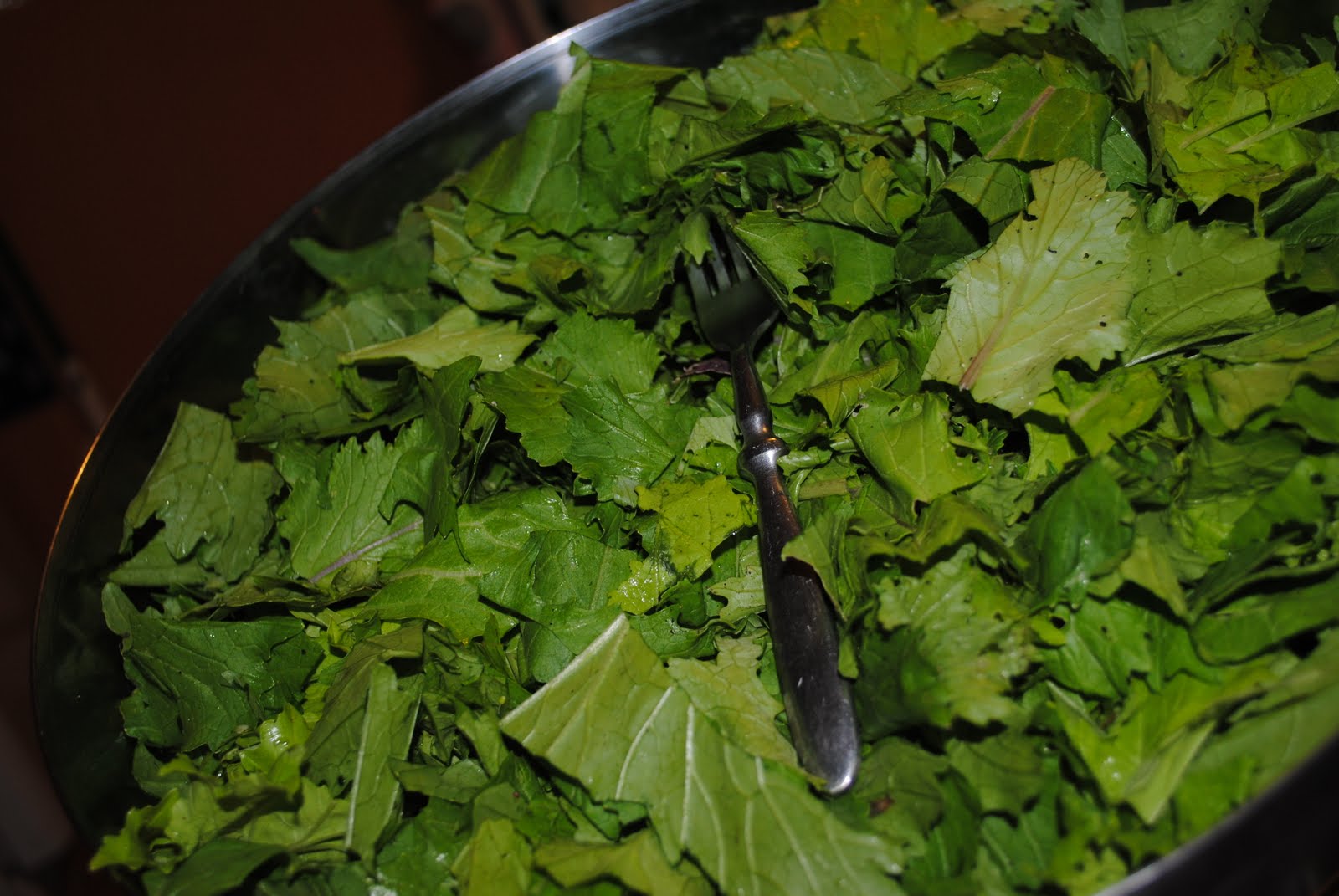
But that was over the winter.  Now that the lettuce is free flowing (at least for another week or so), now that there is kale, endive, tai soi, spinach, arugula, and mustard greens, well, I just can't seem to eat it all.  Funny right?  So I've taken the least desirable stuff, or at leas the stuff I can't eat all day long (like mustard greens) and put them in the freezer.
A couple of years ago we acquired two contractor-grade trash bags full of tai soi.  It was the end of the Harvest at our CSA and they just couldn't spread it around enough.  We figured if we didn't eat it all we could at least give it to our chickens.  But eat it we did!  We chopped, washed and vacuum sealed the whole nine-thousand pounds of this slightly bitter green.  We only just finished eating it this past winter, in fact.  When it was thawed out it was pretty mushy and chewy.  I only learned after the fact that most veggies need to be blanched before they are frozen. This is because blanching destroys the enzymes that allow the veggies to ripen and to rot.  It also sets the color and preserves the nutritional content and flavor.  In short, it prevents thawed greens from tasting like chewy mush fit only for pureeing and hiding in spinach bread and other such things.  There is great information about blanching and freezing veggies here, at the National Center for Home Preservation including a chart with blanching times.  (Here they have a chart from the Joy of Cooking, it includes some other veggies).  Timing is important because under blanching just speeds up the ripening/rotting process and over blanching is actually called cooking, which you can do, but isn't the goal here. 

So, now we blanch.  I had pretty good luck with it last year.  I dehydrated a lot of stuff, but the greens I did freeze came out better.  I decided not to dehydrate as much of my greens this year because they just crumble. So, while they can be added to soups and casseroles as a seasoning, there's never any greens in them. I also froze pepper strips, blanched, but they tasted, um, like frozen peppers...so we still have some.  I found they were usable only in sausage and peppers, covered in sauce.  And eggplant.  I froze a bunch of peeled, sliced, blanched eggplant.  Yeah, we still have most of that left also. 

How to blanch?

1. Wash and Chop your greens.  I like to make them into the basic size I would use them in cooking. For me, part of the benefit of doing all this work in the summer is to make the winters really, really easy.
2. Bring a pot of water to a boil. Prepare a large bowl of ice water in the sink.  This is to put the veggies in after they are blanched to stop them from cooking.  

3.  Put the greens in the water in batches not too big for the pot.  (Isn't that helpful?)  I basically blanch them one bunch at a time (this seems to be about a pound).  You want to make sure the pot isn't so full that the leaves get stuck together, and so don't get blanched.
4. Blanch them for only 2 1/2 minutes.
5. Take them out and plunge them int the ice water. 
This job is a lot easier  If you have a metal basket like this. It is tricky to fish the greens out of the water when the time is up without over cooking them. 
6. After they are cooled completely put them in a colander while you finish of the next batch.

7. Label what it is with the date and freeze them in a freezer bag with as much of the air squeezed out as possible.  If you're iffy about plastic you can use mason jars, just don't fill them too much. I vacuum seal them, but I do find that this is tricky because as the water gets sucked up it prevents the bag from getting a really good seal.  I have found two ways of dealing with this, one press the "seal" button on the vacuum sealer before it's done really vacuuming (and so hasn't had enough time to suck the water up).  I'm not sure all machines have this capability.  The other thing I found works pretty well is to place some paper towels or coffee filters above the food inside the bag.  This way the water gets absorbed into this and doesn't interfere with the seal.
 That's it! Then just wait to unity you would maim someone for a leafy veggie and thaw out the mustard greens!

Monday, June 14, 2010

Lavender

I have three beautiful bushes of lavender that I have had since I was fist a Momma.  They were in containers in our first apartment as a family, and now that they have been allowed to rest in the ground for about three seasons, they are gorgeous!
These will be hung to dry and used in baths salts, poultices and given away as gifts in the form of eye pillows, most likely!

Sunday, June 13, 2010

Strawberries Are The Jam!

Last year we prepared an 8'x4' just for strawberries.  They are June bearing sweet beautiful tasty berries.  They started ripening about two weeks ago, and the kids have been snacking.  Athena is especially fond of using a knife (very exciting) to cut them into minute pieces and eat them out of a bowl. Unfortunately we don't really have enough at this point to let them snack at will.  My oldest will happily eat a green strawberry, so she can clear a crop faster than a murder of crows.  We do have a couple of patches of wild strawberries where they have free range. We hope to plant more June bearers and ever bearers in the future.  But for now, this is what we have and a couple of days ago I had enough to make twelve jars of jam! I am also freezing the berries whole to use in smoothies.  I think that we will probably end up going to a pick your own and getting a bunch for freezing and jamming this week. 
We had about 8 cups mashed which was enough for a double batch..  I use Pomona's which is activated by calcium and so you don't need a lot (or any) sugar to make the jam jam.  (Sorry, I can't seem to help myself). I use the inversion method to seal the jars.  It's my understanding that this means I can't enter my jam j-ahem-in any fairs or contests?  I guess this has something to do with bacterial. But I have seen old pros use this method and I can't bear the thought if boiling them again! However, after double checking my facts just now, I am adequately paranoid* and will probably process them in a water bath, given that we give a lot of jams away as gifts. 


*When the inversion process does work, the vacuum seals of filled jars still tend to be weaker than those produced by a short boiling water canning process. A weak seal is more likely to fail during storage. In addition, the headspace of the jar may retain enough oxygen to allow some mold growth if airborne molds contaminated the surface of the product as the jar was filled and closed. More complete removal of oxygen from the headspace also offers some longer protection from undesirable color and flavor changes with some types of fruit products.

Friday, June 11, 2010

The Trade Off

 Ugh.  Well, we're in a little over our heads.  Again.  This is something that seems to happen to us a lot.  We get excited.  We see an extremely pleasurable end product.  Then we try to run and leap over all the learning that has to come before in order to actually achieve that extremely desirable end product.  Usually it happens with animals.  More than once (I hate to admit) we acquired animals and then scrambled to build, find, expand the home for said animals.  It is very easy to see, with alive things, that you have missed a couple of steps, chickens get cramped, bunnies have babies, and lettuce bolts.  For this very reason we decided not to get any additional animals this year and just focus on preserving our foods and getting our yard ready for more planting ability.  We did plant quite a bit.  We ordered our seeds and made a little calender during the cold and easy-paced winter months (the calender has been completely ignored).  We built cold frames and started our seeds in them and under lights in the kitchen.  We even rented a community garden plot again at a local land trust in hopes of having better luck with our tomatoes this year (last year's attempts got gotten by the blight).

Well, many of the things we started from seed indoors looked wimpy,  and a bunch of the things we started in the cold frames needed/needs to be transplanted and just hasn't yet.  I'm not really even sure why.  I guess I don't really have a lot of time to do that sort of thing.  But I'm not really sure at this point what I am doing instead.  I guess taking care of my kids?  They're practically feral, so I can't imagine that it's taking up that much of my time.  For a while I was getting up at 5:30, an hour before the family, so I could do some outdoor things in peace.  It was really, really nice, actually.  I felt like I was getting some time to myself and getting some nagging projects done.  But then I started wanting to not get up at 5:30 am and instead sleep in (until 6:30).  What a looser.  So I guess I will have to get back on the "getting up like a crazy person or a runner (same thing) at the crack of dawn" thing and transplant some basil and zinnias.

We have deiced to forgo the garden plot.  Although it's in a place that I frequent with the children and it's only a mile away, so not far for us to walk, it seems unlikely that I will be able to walk there everyday at a regular time to water, weed and harvest.  It's a little too much strain on my primary job which is parenting.  I know there are some super women out there who do it and any tips would be great.  But I am not She just yet and if I have to do the garden march of tears everyday my children will get yelled at, ignored, and have a generally cranky mom.  It's just not the holistic nature-y childhood I'm trying to cultivate for them.  We have also decided not to stress too much about the things we have started and could be harvesting by now.  Instead we've deiced to just get the yard ready to plant in the fall for our winter greens and carrots and things like that.  We put the unused seeds in the refrigerator and will just wait until next time to try again.  We are a part of two farm shares this summer and should have plenty of produce to eat and preserve without trying to learn so quickly under summer pressure.  I mean, we seriously still don't know all that much about cultivating soil.  Again, with the house for your alive things! 

 Last year we purchased the Rail Road ties to the right for a ridiculously cheap price.  This year we are planning to make four beds about 3.5'x9' in this spot to give us more gardening space.  My husband is holding up the root of a forsythia that was in our way.  I have so many of them, and am not such a big fan to begin with so I deiced we would just dig it up without trying to transplant

There is just so much to learn, and I am so impatient to know it all now! But I don't.  And we've only been learning in earnest for two or three years.  In that time we have learned a lot. I can remember being around seven months pregnant with Athena and kind of panicking about teaching her about wild edibles and herbs.  I felt really hormonal about her not loosing this ancestral knowledge about the earth and its cycles.  Something I was determined to teach her, and that I would have to learn in like TWO MONTHS! I'm not sure if you know this, but a few minutes after they are born they start wondering about when nettles grow and the various ways to prepare them, as well as their health benefits.  It's a fact and you'd better get ready.  Anyway, I managed to take it one step at a time, and I can now safely pull together a wild meal as well as cure bug bites, open wounds, skin rashes and lighten the flow of a heavy period.  As a family we're getting there.  To my delight my kid could tell the difference on sight between peppermint and spearmint at the age of three. They are definitely picking up a sense of the earth's timing and offerings. There is just so much more to learn.  Perhaps the lesson in this, as in all things, is to be contented or even joyful with the process of learning.  Because surely, if it's done right, that never stops.
 
I guess I'm not willing to miss watching  Athena help her little sister "birth" her baby cat, even if it means a slower learning curve and less homemade ketchup.